From AI to Knowledge Graphs, more and more companies are discovering the power and usefulness of semantic data to open up new business capabilities and support current programs.
Semantic data models are different from other types of data models in that they incorporate both the meanings of the terms and their relationships. Customer Relationship Management (CRM) systems, for example, can benefit from using semantic data models because they can integrate information from multiple channels, creating more robust customer profiles and supporting a streamlined customer experience.
Semantic data models are complicated, and we’ve seen even seasoned data professionals who are unfamiliar with them. So, in the spirit of cooperation and support, we’re sharing a couple of useful things to understand about this model.
The Role of Uniform Resource Identifiers
Probably one of the most important things to understand is the use of Uniform Resource Identifiers (URIs) as a sole identifier. A URI can be used to identify and distinguish any object in a semantic system. URIs are ideal because they can be used to trace any concept in a system back to its origin in the semantic management system.
So even if a concept changes its label, the URI stays the same. For example, the concept of “cars” might be relabeled to “automobiles.” Instead of having to make multiple changes in multiple consuming systems, a consuming system can just use the URI to identify the term and get the current metadata, including the updated label. This allows consuming systems, like those used by AI models, to identify the concept as being the same. It also preserves data continuity while creating a solid foundation that is flexible and responsive to change.
This is the benefit of semantic data and URIs. If the data consuming systems rely on a potentially-changing identifier such as a term label, then updating the information in downstream systems will require building mapping tables or other crosswalks to connect the term to its old label. This is the only way to maintain data consistency.
Mistakes to Avoid When Using Semantic Data
- Don’t assume semantic data is hierarchical.
Semantic data may not be hierarchical in structure. Knowledge graphs, or any semantic system which uses a graph structure, could potentially contain multiple relationships, most of which are not hierarchical.
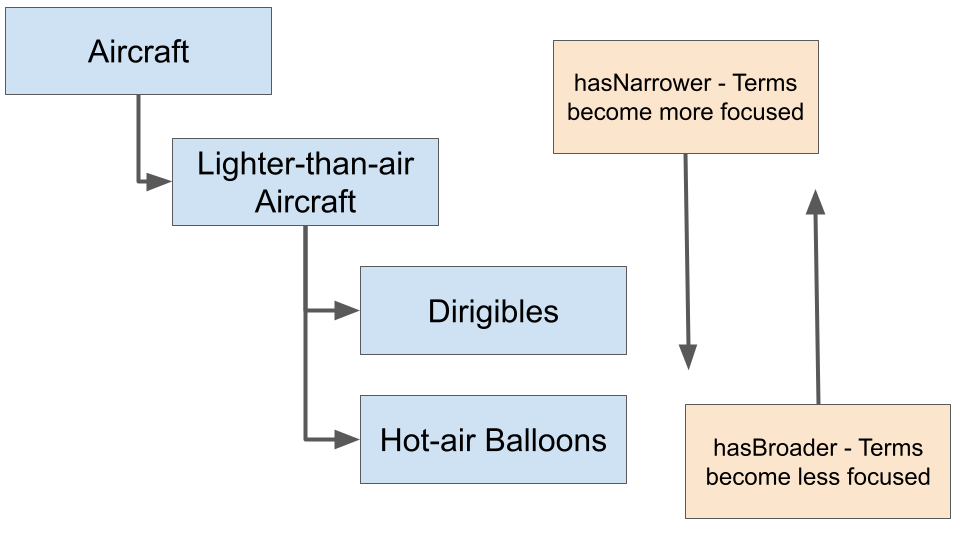
However, this does not mean that semantic data is never meant to be hierarchical. The main point to understand here is the use of relationships as a way of denoting information. For example, a simple way to determine whether that semantic data is meant to be hierarchical is the use of the “has broader” and “has narrower’ relationships in SKOS. Since relationships themselves can convey information, it is important for those working with the data to check and understand those relationships.
Here’s a visualization of the “has broader”/”has narrower” relationship with example concepts.
- Make sure your teams are using the same schema standards.
Another thing that can trip up some teams is the use of different implementations of schemas, which can have different properties and abilities. It is important for both information and data workers to decide on which schema standards they will be using.
For example, RDF-star allows for properties to be added to the relationships between objects. So semantic systems using RDF-Star could have properties given to relationships while those built on the basic RDF schema would not.
Good communication and an understanding of the schema are key for both the information and the data teams to collaborate effectively.
When it comes to data and information work, inconsistencies anywhere can mean inconsistencies everywhere. In our work, we’ve seen technical teams misunderstand the structure of data or the use of a non-label identifier. That caused issues when we were planning to make updates or utilize certain capabilities of the semantic system.
If your team doesn’t have an understanding of how semantic data differs from other data formats, the results can be costly and time-consuming: misaligned data products, additional complexity, flawed integrations, and even AI initiatives that can’t be scaled.
Semantic literacy is a critical skill for both information and data professionals to cultivate so that they can design and utilize data systems and integrations in a way that supports your business and opens up new capabilities for the enterprise.